BPMs, Song Structures and the Art of Visual Music — What Makes a Great Live Content Creator

Updated: Apr 27

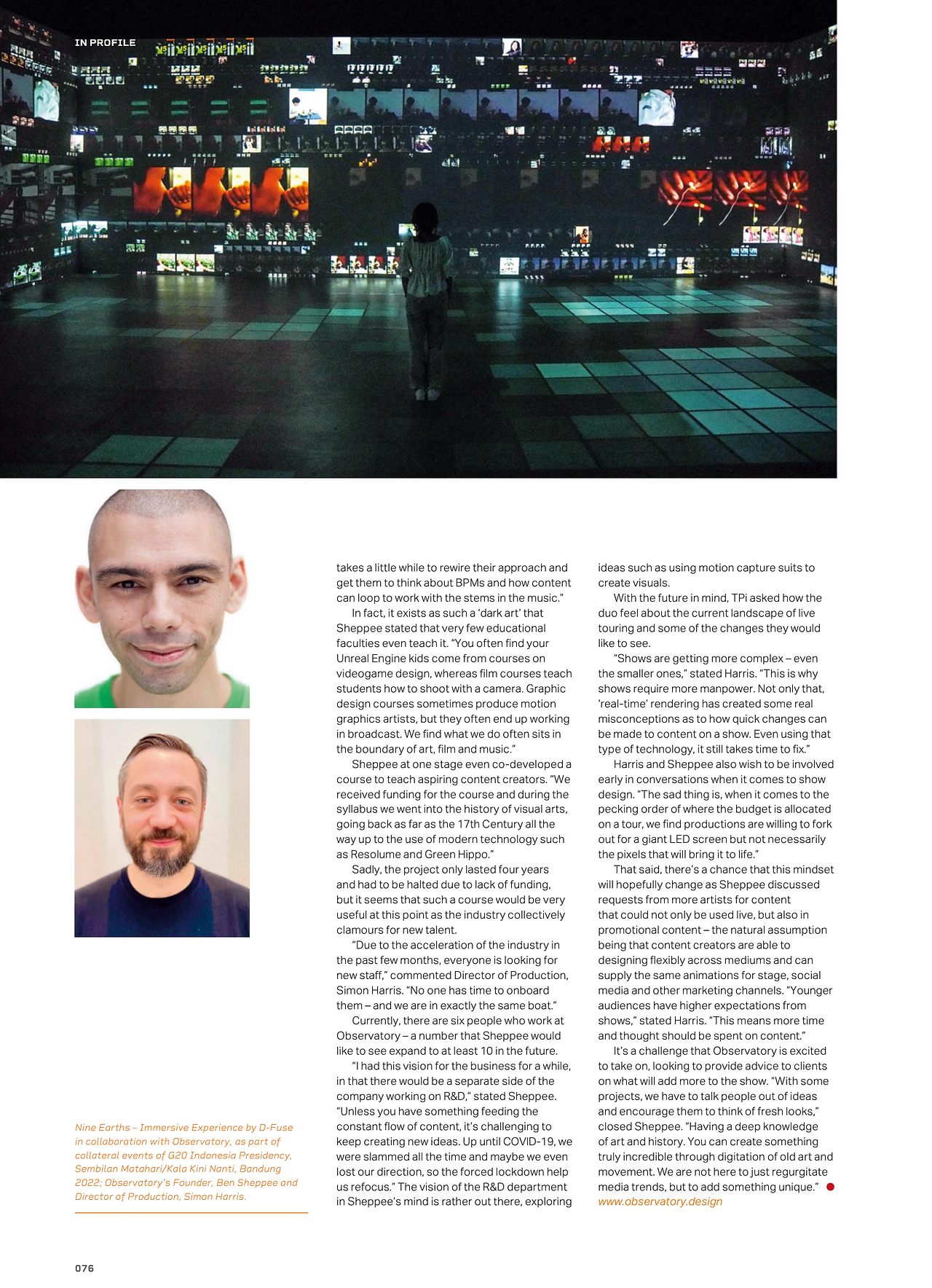

If you were to design a curriculum for training the perfect live visual content creator, you'd quickly realise there isn't an obvious existing model to copy. The discipline sits between fine art, graphic design, film, music, software engineering and live event production — and most educational programmes only cover one or two of those.
This is a problem that Ben Sheppee has thought about seriously and spoken about publicly. His observations about the talent landscape in live visual content creation are worth examining in detail — because they reveal something fundamental about what Observatory looks for when it builds its team.
The Dark Art Nobody Teaches
"You often find your Unreal Engine kids come from courses on videogame design, whereas film courses teach students how to shoot with a camera. Graphic design courses sometimes produce motion graphics artists, but they often end up working in broadcast. We find what we do often sits in the boundary of art, film and music."
That gap — the space between the existing disciplines — is exactly where Observatory lives. And because nobody formally teaches this area, finding people who are naturally suited to it requires a particular kind of search: looking for people whose background spans multiple domains, who are genuinely curious about all of them, and who have the creative and technical confidence to operate without a well-worn educational pathway to guide them.
Why Understanding Music Is Non-Negotiable
For Observatory, one of the most important qualities in a live content creator is musical understanding. Not necessarily the ability to play an instrument, but a genuine feel for rhythm, structure, dynamics and emotional arc. "Creating a visual response to music is somewhat a unique set of skills," Sheppee noted. "I used to play piano; my colleague Simon and I were in a band together in the '90s and having an understanding of music and song structures definitely helps. When creators don't have that background it takes a little while to rewire their approach and get them to think about BPMs and how content can loop to work with the stems in the music."
This is the thing that separates adequate content from genuinely musical content. When a visual loop resolves at the right moment, when a motion arc completes on the downbeat, when a transition happens at the exact point the music demands — the audience feels it even if they couldn't explain why. That's the craft that matters.
The Course That Was, and Why It Should Exist Again
Sheppee has gone beyond critique — he attempted to solve this problem directly. He co-developed a course to teach aspiring content creators, receiving funding for the course, during which the syllabus went into the history of visual arts, going back as far as the 17th century all the way up to the use of modern technology such as Resolume and Green Hippo.
Sadly, the project ran for four years before funding ended. But the vision remains. Observatory's partnership with the University of Greenwich's Animation department is a continuation of that same impulse — contributing to the educational pipeline that will produce the content creators this industry so urgently needs.
What We Look For
When Observatory hires, we look for: deep software proficiency in 3D tools (Cinema4D, Unreal Engine, Houdini); genuine aesthetic sensibility informed by art history and design; a feel for music and rhythm; the curiosity to keep learning; and the emotional intelligence to understand what an audience is experiencing and design towards that. It's a rare combination. When we find it, we hold on to it.
Sources: TPi Magazine — https://www.tpimagazine.com/observatory-the-importance-of-content-creation/


